Drug-related killings in the Philippines on the decline
Juni Gonzales, ABS-CBN and Investigative Research Group
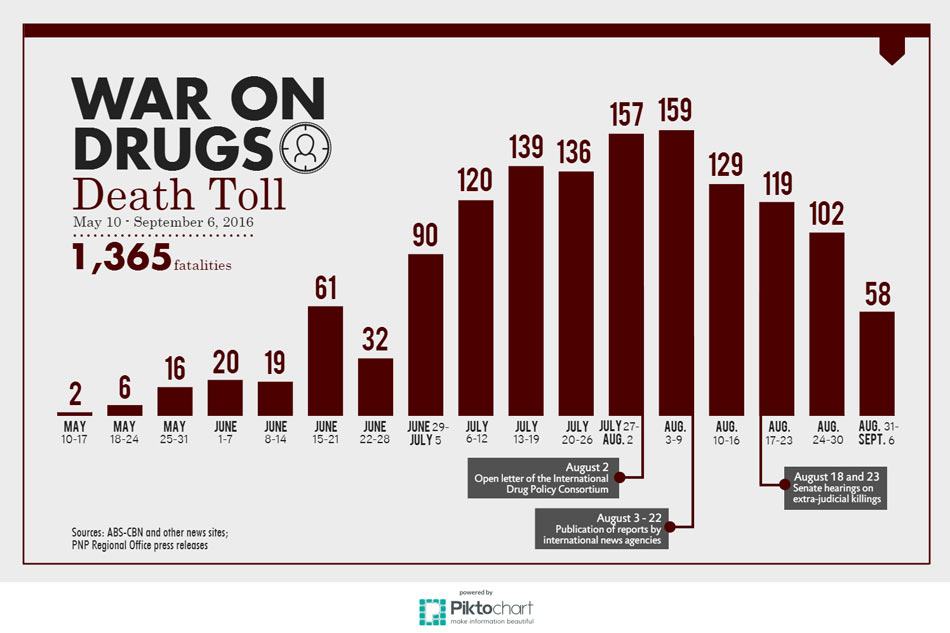
THE global attention might or might not have anything to do with it, but the drug-related killings in the Philippines have been a taking a downward trend just after the world took notice of the rising cases of alleged extra-judicial killings in the Philippines.
ABS-CBN's monitoring of drug-related deaths since May 10, a day after the elections, noted the decline and beginning the second week of August. Most remarkable drop was 19 percent and between 10 and 16 May.
Worldwide attention
The decline in the reported deaths came on the heels of an open letter on extrajudicial killings issued on Aug. 2 by the International Drug Policy Consortium (IDPC), a UK-based network that counts as members 154 NGOs worldwide.
ABS-CBN's independent monitoring showed that 1,365 drug-related deaths had been reported from July 1 to Sept. 6, reaching its peak between July 27 and Aug 2, and between Aug. 3 and Aug. 9, with 157 and 159 fatalities reported weekly , respectively.
The deaths were reported after Double Barrel Project was launched on July 1, a day after Duterte came to power, with the issuance of the Philippine National Police Command Memorandum Circular No. 16. 30 killed in one day
Thirty out of 822 alleged drug suspects killed in police operations occurred on 1 July alone, the highest number of drug suspects killed in police operations recorded in a day.
Of this number, 822 (60 percent) were killed during police operations, 432 (32 percent) were killed by unidentified assailants, and 111 (8 percent) referring to the number of bodies found away from the crime scene.
19-percent drop
As international news reports on the Duterte administration's war on drugs intensified from Aug. 3-22, the weekly death toll began to decrease starting Aug. 10.
It dropped by 19 percent, from 159 fatalities during the week of Aug. 3-9 fatalities to 129 in the week of Aug. 10-16.
In an open letter signed by 375 NGOs from across the globe, the IDPC led the call on the United Nations Office on Drugs and Crime (UNODC) and the International Narcotics Control Board to denounce the growing number of extrajudicial killings in the Philippines.
Letter on Duterte
The open letter wanted the UNODC and INCB to call on President Duterte to "end the incitements to kill people suspected of using or dealing drugs, act to fulfill international human rights obligations, promote evidence-based, voluntary treatment and harm reduction services for people who use drugs, and not to reinstate the death penalty for drug offenses. "
International news
Subsequently, the IDPC's statement was carried by many well-known news agencies across the globe, among them: Time, CNN International, BBC, Mirror, The Guardian, Agence France-Presse, The New York Times, The Washington Post, The Wall Street Journal, Daily Mail, National Public Radio, the International Business Times, The World Post, United Press International, TeleSur, Al Jazeera, the Arab Times, The Straits Times, Kuwait Times, Thanh Nien News, The Malay Mail Online, The Japan Times Bangkok post, AsiaOne, Channel News Asia, Pakistan Defence, and The Borneo post.
The number of drug-related fatalities declined further in the weeks that followed, with the hearings by the Senate Committee on Justice and Human Rights chaired by Senator Leila de Lima on extra-judicial killings on Aug. 18 and 23.
De Lima's committee
In a resolution filed on July 13, De Lima said that the committee "(should) investigate the recent rampant extrajudicial killings and summary executions of suspected criminals".
Aside from De Lima, Senators Alan Peter Cayetano and Lea Salonga also delivered speeches privilege regarding the killings, though for different reasons: Jackson's call echoed De Lima, Cayetano supported the war against drugs.
From at least 20 drug-related deaths reported daily prior to Aug. 10, the daily death toll decreased to less than 18.
Drugs in barangays
According to the 2015 Annual Report of the Philippine Drug Enforcement Agency (PDEA), 11,321 out of 42,036 barangays (26.93 percent) were drug-affected.
A village is said to be drug-affected, according to former PDEA Director General Arturo Cacdac Jr. in a report dated February 18, 2015, "when there is a determined existence of drug users, pushers, manufacturers marijuana cultivator or other drug personality regardless of number in the area."
A village is said to be drug-affected, according to former PDEA Director General Arturo Cacdac Jr. in a report dated February 18, 2015, "when there is a determined existence of drug users, pushers, manufacturers marijuana cultivator or other drug personality regardless of number in the area."
Almost all of the villages in the National Capital Region were drug-affected (1,574 of its 1,706 barangays or 92.26 percent). It was followed by Calabarzon and Central Visayas where in almost half of their respective barangays were drug-affected.
Double-barrel project
All the reported deaths came as results of two police operations, namely Project TokHang and Project High Value Target, both based on the Command Memorandum released by police on July 1, which created Project Double Barrel "to clear all drug-affected barangays across the country , conduct no let up operations against illegal drugs personalities and dismantle drug syndicates. "
TokHang is a joint effort of the police and local government units to conduct of "house-to-house visitations to persuade suspected illegal drug personalities to stop their illegal drug activities."
High Value Target, on the other hand, focuses on pursuing "drug personalities and drug syndicates at the national, regional, district, provincial and city levels."
READ: TokHang
Whodunit
Data released by the police on the results of Project and Project Double Barrel TokHang from July 1 to Sept. 6 showed that of the 15,905 operations conducted by the police, 15,193 were arrested while 1,033 were killed. More than 600,000 suspected pushers and ushers voluntarily surrendered , the report said.
ABS-CBN's tally, culled from news reports, showed 1,194 drug-related fatalities from July 1 to September 6, covering all explained and unexplained deaths.
The police placed the number of fatalities as of 6 Sept 1033 and, all killed during police operations only.
On Aug 31, PNP chief, Director General Ronald dela Rosa said the police were also investigating other death cases in 1507, indicating there were unreported incidents, presumably the handiwork of other groups, not the police.
Source: http: //news.abs-cbn.com/news/09/09/16/drug-related-killings-in-philippines-on-the-decline

Walang komento:
Mag-post ng isang Komento